Istanbul: In A Day
- Ajeng Araini-Kusno

- 24 Mar 2023
- 5 menit membaca
*This post is dedicated to Turkish earthquake victims and their families

For me, Istanbul is the most beautiful city in the world. Istanbul is located on the edge of Europe and Asia, facing the Sea of Marmara and the Bosphorus Strait. Its beautiful landscape became more magical with its magnificent heritage buildings.
Indeed, you need more than a day in Istanbul. But, if you only had a day, here are places I recommend you visit. Of course, you can't visit all these places in a day, but you can always choose what suits you best.
Hagia Sophia and Blue Mosque

Hagia Sophia or Ayasofya is located in the Sultanahmet district in the old town of Istanbul. It is formerly a Byzantine Orthodox Basilica built in 537 AD. In 1453 the Ottoman Empire transformed the church into a mosque. The mosque was then used until 1935 when the founder of the Turkish Republic, Mustafa Kemal Ataturk, changed it into a museum. However, in 2020 Hagia Sophia was transformed back into a mosque.
As the building is a true architectural wonder, thus, Hagia Sophia was made a UNESCO world heritage site. It is also unique because it has both decorative elements of a church and a mosque. Hagia Sophia is also an inspiration for the Ottoman's Sultanahmet Mosque or widely known as the Blue Mosque, located just across from Hagia Sophia.

The Sultanahmet Mosque or the Blue Mosque was constructed in 1609-1616 during the rule of Ahmed I. The mosque is also a UNESCO world heritage site. The mosque's interior walls were adorned by hand-painted blue tiles. As a result, as the light comes from its domes, the mosque is usually bathed in blue colour inside, making the mosque famously known as the Blue Mosque.
If you are a Moslem tourist, I advise you to go inside the mosque and do pray. Based on my own experience when I did that, the feelings were beyond words. I also advise you to go to Sultanahmet Square where you could take pictures with either the Blue Mosque or Hagia Sophia, by only turning your back in a different direction. It will be another amazing experience, and obviously, good for your social media posts!
When I was there in 2010 my grandmother told me that she and my grandfather were there too, back in the late 1950s! Wow! I bet there won't be plenty of Southeast Asian tourists back then in Istanbul...
Topkapi Palace and Dolmabahçe Palace

Topkapi Palace Museum or Topkapi Sarayi Muzesi is within walking distance from the Hagia Sophia. The palace is another UNESCO world heritage site, constructed in 1459 during the reign of Sultan Mehmed the Conqueror. From its establishment until 1856 Topkapi Palace served as the administrative center of the Ottoman Empire, as well as the royal residence of the Sultans and their families.
After the Ottoman ends, in 1924 the government of the Turkish Republic transformed the palace into a museum. Topkapi is a medieval palace with marvelous Islamic art decorative elements. Not only preserving the architectural beauty the palace also houses Ottoman regalia: clothes, weapons, armor, as well as Islamic religious relics. Visitors could also enter its Imperial Council, the palace kitchen, and the Harem - the woman's quarter. I highly recommend you rent the audioguide, as without it you will be "lost" without any information.

In the mid-19th century, the Ottoman moved its court and royal residence to the new royal palace: Dolmabahçe. The Dolmabahçe Sarayi Muzesi or Dolmabahçe Palace Museum is located within the Beşiktaş district, on the coast of the European Bosphorus. The palace was built during the reign of Abdülmecid I and was a modern European palace.

The Dolmabahçe Palace has a symmetrical design. The Sultans could enter it from either the Bosphorus or from the street. The exterior and the interior of Dolmabahçe are, indeed, very grandeur with its crystals, gold, chandeliers, carpets, tapestries, and paintings. Its styles are a combination of the Baroque, Rococo, Neo-Classical, and Ottoman styles. The palace was also installed with the modern technology of its time: gas lighting, water closets, a central heating system, and elevators. According to Wikipedia, the palace cost approximately $1.9 million in today's gold value! Wow!

Back in 2010 when I visited Dolmabahçe Palace I need to wear a particular plastic to cover my shoes for historical building preservation. Then I need to go around the palace with their in-house guided tour. It was an amazing experience. We passed through the famous crystal staircase, see one of Sultan's Hamam, enter the Pink Hall and the Harem, as well a peek into Attaturk's room.
Indeed, after the Ottoman rule over, Attaturk became the first president of the Republic of Turkey. He then used Dolmabahçe Palace as his summer presidential palace. Attaturk even died in his room in Dolmabahçe in 1938 and within the room, the clock was set to 9.05 am after his death.
Grand Bazaar

One of the must-visit places in Istanbul is the Grand Bazaar, the largest and oldest indoor market in the world. Grand Bazaar was constructed in 1455/1456 right after the Ottoman conquest of Constantinople. For one who loves shopping, you may need a couple of hours inside the Grand Bazaar as Grand Bazaar sells almost everything, from jewelry to carpets, from porcelains to Turkish delights. Grand Bazaar also has plenty of cafes.
Even after 13 years, I can still remember the sweet smells of baklava inside the Grand Bazaar. I remember the excitement of shopping inside the world's oldest indoor market, although I only bought porcelains for my mother and a Turkish red Fez for my father. I also remember the smile of a handsome Turkish boy, helping his father who tried to sell carpets to me.
Nostalgic Tram on Istiklal Caddesi
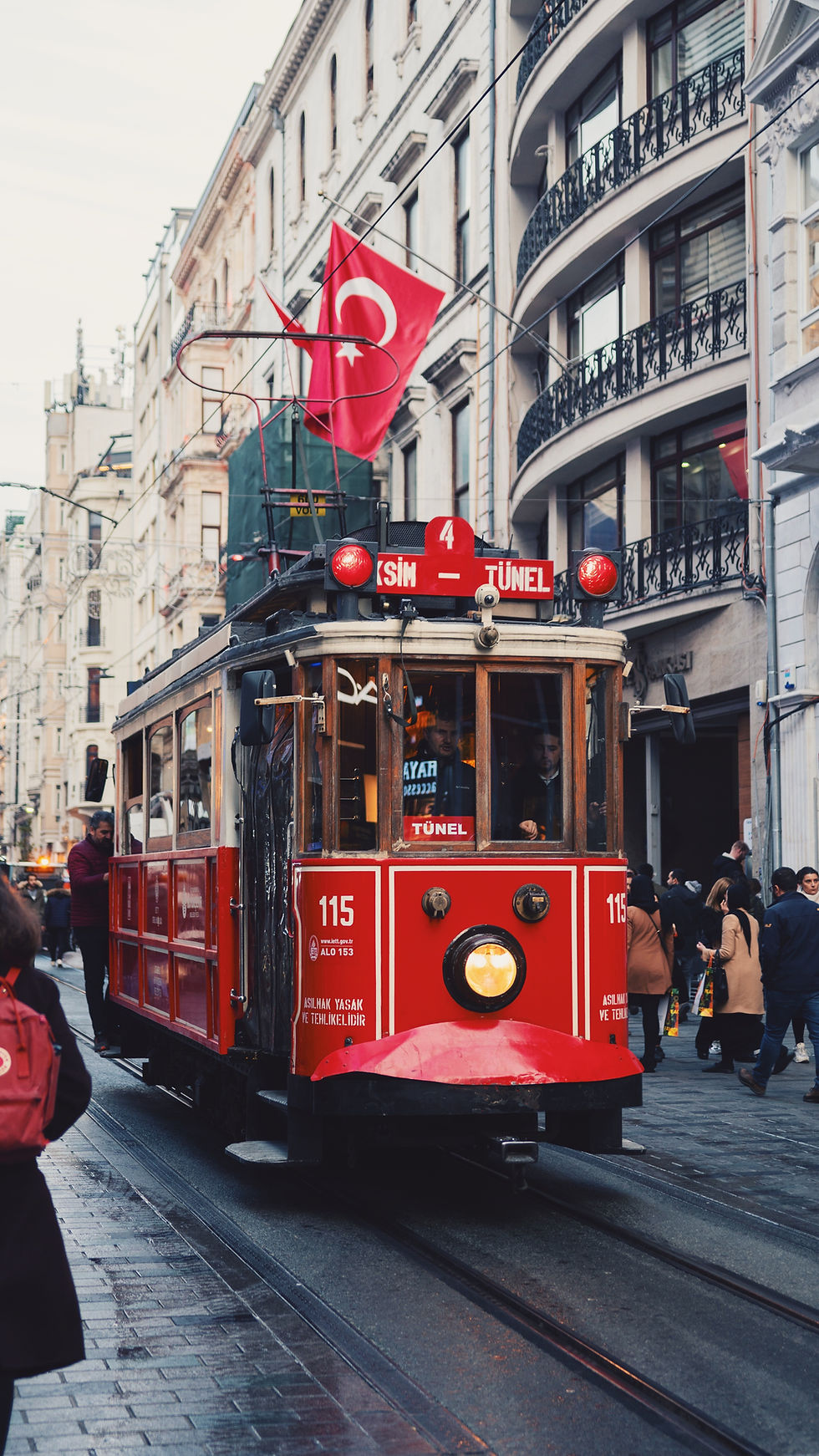
As a history geek, one thing I also recommend you during your visit to Istanbul is to take this nostalgic tram on Istiklal Caddesi. Istiklal Caddesi or Istiklal Street is a pedestrian shopping street near Taksim Square. The red nostalgic tram runs from Taksim to Tunel along Istiklal Caddesi.
From 1869 to 1966 horse-drawn trams - and later electric trams, ran in Istanbul. In the 1990s two nostalgic routes were reopened. One route runs within Istanbul Asia, and the second route runs in Istanbul Europe, this Taksim-Tunel route.
I took this red retro tram back in 2010 along Istiklal Caddesi. Surprisingly, the ride reminded me of my childhood tram ride experience (with my grandmother) in San Fransico, another world's most beautiful city.
Kiz Kulesi

Last but not least, Kiz Kulesi or Maiden's Tower is surely a place you can't miss in Istanbul. Located in the Bosphorus, it is exactly right in the middle between Europe and Asia.
Back in 2010, they serve fine dining breakfast, lunch, and dinner at the restaurants downstairs. While coffee and snacks are served upstairs at the cafe. From the cafe, we can get out of the tower to the open terrace and enjoy the stunning view. Kiz Kulesi is, definitely, a perfect place for a wedding proposal too!
I recommend you take a ferry (from Üsküdar-Salacak or Kabataş) and enjoy the dining experience there. Undoubtedly it will be expensive, but you won't experience dining between two continents every day, right? So, enjoy Istanbul!


Komentar